

ITS Logistics January Supply Chain Report: Transportation Markets Show Early Signs of Capacity Challenges Despite Soft Demand
-- Dry van market cools after tight peak while reefer challenges persist; imports, inventories, and consumer demand remain subdued --
RENO, Nev., Jan. 29, 2026 (GLOBE NEWSWIRE) -- ITS Logistics, one of North America’s fastest-growing 3PLs, today released its January Supply Chain Report. This month, the report highlights early capacity constraints that may signal challenges for the 2026 truckload markets, as well as end-of-year port performance and evolving warehouse trends driven by new inventory strategies and cautious consumers.
Truckload markets tightened meaningfully in December. Seasonal holiday demand combined with disruptions from the first major winter storm drove dry van load-to-truck ratios to 9.9 — the highest in the current market downcycle. While the market cooled leading into the new year, capacity remains tight as carrier exits continue, and van rates remain notably above historical averages. Reefer capacity has shown even more aggressive signs of sustained tightening, with demand and rates remaining elevated through mid-January as winter produce season converges with a second round of winter storms. The USDA is currently reporting an “unusual scarcity” of available trucks in California, with similar constraints and rising spot rates reported across Mexican import gateways and key produce lanes, where carriers are becoming more selective amid tightening availability. Though the market has seen marginal cooling following the six-week surge, rates remain 18% above the five-year average.
“January reefer activity has offered an early glimpse into potential capacity challenges for demand cycles in the coming year,” said Josh Allen, Chief Commercial Officer at ITS Logistics. “Ongoing regulatory changes, carrier exits, and unexpected events like Storm Fern will continue to shrink the margin for overcoming disruption that we’ve become accustomed to as a result of prolonged excess capacity — even if demand remains muted.”
At the ports, December volumes underscored an ongoing soft environment. U.S. container imports totaled 2,227,316 TEUs, down 5.9% year-over-year. Full-year 2025 import volumes finished 0.4% below 2024 levels, reversing the nearly 10% growth margin seen earlier in the year as frontloading faded and consumer demand softened. Month-over-month, however, volumes rose 2% from November, marking one of the stronger Decembers of the past decade, despite seasonal slowdowns.
Performance across gateways was mixed, with several smaller ports posting notable gains. These rebounds come after a year of uncertainty driven by geopolitical tensions and proposed port call fees tied to Chinese-built vessels, which had raised concerns about volume diversion away from smaller gateways. In an interview with FreightWaves, Port of Oakland’s Maritime Director stated that while the gateway’s total container volume for 2025 was flat (0.4% over 2024 levels), it was considered a “notable outcome” in the face of ongoing uncertainty and volatility.
Early consumer reports state that holiday retail sales grew approximately 4% year-over-year, reflecting resilient but cautious consumer spending, despite ongoing uncertainty. Consumer confidence weakened further in December, with the Conference Board index falling to 89.1 for the fifth consecutive monthly decline as inflation pressures eased only modestly and labor markets continued to cool.
That dynamic is now visible across the warehousing landscape as the industry enters 2026. In December, the Logistics Managers’ Index registered 54.2, its slowest pace of expansion since April 2024, as firms continued to draw down inventories without replenishing. Throughout the month, warehouse utilization fell to historically low levels, positioning retailers for a year of lean inventory strategy with a focus on sell-through. While utilization softened, warehousing prices remained elevated due to persistent labor and facility cost pressures.
“This release of warehouse capacity was driven primarily by inventory behavior, not new supply, creating short-term rate options for shippers and margin pressure for operators,” said Ryan Martin, President of Distribution and Fulfillment for ITS Logistics. “The inventory status can also be tied to the current U.S. tariffs, existing inventory carrying costs, and retailers who are deliberately and strategically keeping inventory lean, while wholesalers and other intermediaries are bearing a larger share of the overall experienced burden.”
ITS Logistics offers a full suite of network transportation solutions across North America and distribution and fulfillment services to 95% of the U.S. population within two days. These services include drayage and intermodal in 22 coastal ports and 30 rail ramps, a full suite of asset and asset-lite transportation solutions, omnichannel distribution and fulfillment, LTL, and outbound small parcel.
The monthly ITS Supply Chain Report serves to inform ITS employees, partners, and customers of marketplace changes and updates. The information in the report combines data provided through DAT and various industry sources with insights from the ITS team. Visit here for a comprehensive copy of the report with expected industry insights and market updates.
About ITS Logistics
ITS Logistics is one of North America's fastest-growing, asset-based modern 3PLs, providing solutions for the industry’s most complicated supply chain challenges. With a people-first culture committed to excellence, the company relentlessly strives to deliver unmatched value through best-in-class service, expertise, and innovation. The ITS Logistics portfolio features North America's #18 asset-lite freight brokerage, a top drayage and intermodal solution, an asset-based dedicated fleet, an innovative cloud-based technology ecosystem, and a nationwide distribution and fulfillment network.
Media Contact
Amber Good
LeadCoverage
amber@leadcoverage.com
A photo accompanying this announcement is available at https://www.globenewswire.com/NewsRoom/AttachmentNg/df11896e-7621-4aff-8edd-9dacae5cf91e


ITS Logistics January Supply Chain Report
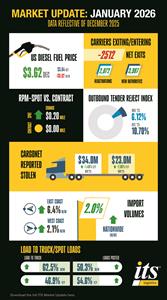
Transportation Markets Show Early Signs of Capacity Challenges Despite Soft Demand
Legal Disclaimer:
EIN Presswire provides this news content "as is" without warranty of any kind. We do not accept any responsibility or liability for the accuracy, content, images, videos, licenses, completeness, legality, or reliability of the information contained in this article. If you have any complaints or copyright issues related to this article, kindly contact the author above.
