

Turkey's New Hourly Netting Reshapes Solar Economics as Energy Storage Emerges as Critical Profit Protection Strategy
Pylontech
Pylontech demonstrates how commercial and industrial businesses can restore ROI under Turkey's new solar regulations through advanced battery energy storage.
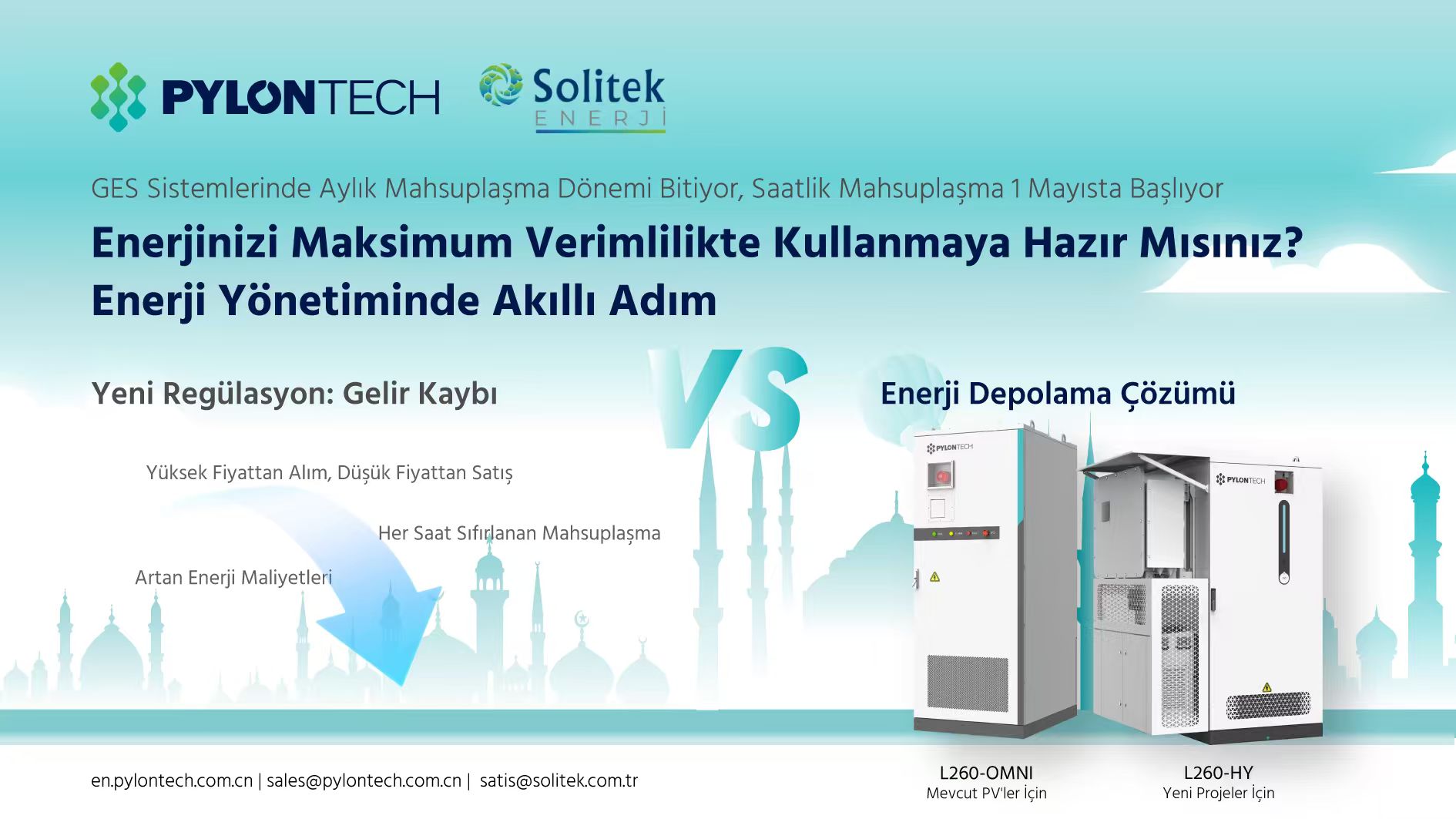
ISTANBUL, TURKEY, June 24, 2026 /EINPresswire.com/ --Turkey's Commercial and Industrial (C&I) solar sector entered a new era on May 1, 2026, with the full implementation of the country's "Hourly Netting" regulation. Combined with significantly higher distribution fees and the introduction of the "1x Sales Limit," the new framework is fundamentally changing the economics of solar investments and creating substantial revenue challenges for photovoltaic (PV) systems operating without energy storage.
As enterprises adapt to this new market reality, energy storage is rapidly transitioning from an optional enhancement to a critical component of long-term solar project profitability. Pylontech, a global leader in energy storage solutions, is helping businesses navigate these regulatory changes with tailored Commercial and Industrial Battery Energy Storage System (BESS) solutions designed to maximize self-consumption and protect energy assets.
## End of the "Grid as a Free Battery" Era
For years, Turkish solar investors benefited from a monthly netting mechanism that allowed excess electricity generated during daylight hours to offset consumption during nighttime periods. Under the new regulation published in Official Gazette No. 33212, facilities that received grid connection approval after May 12, 2019, are now subject to a netting period limited to just 60 minutes.
The impact is significant. Excess solar production generated at midday can no longer be used to offset higher-cost electricity consumption later in the evening. The grid can no longer serve as a virtual energy storage asset, leaving solar producers exposed to timing mismatches between generation and consumption.
For many industrial facilities, this mismatch represents a major challenge, particularly where peak solar production and peak operational demand occur at different times of the day.
## The Growing Gap Between Electricity Purchase and Sale Prices
One of the most challenging aspects of the new policy is the widening disparity between electricity purchase costs and compensation for exported solar energy.
Under current tariff structures, the total cost of purchasing electricity from the grid—including energy charges, distribution fees, and taxes—reaches approximately **6.10 TL/kWh**.
By contrast, when businesses export unused solar energy to the grid, distribution-related deductions reduce actual compensation to approximately **0.97 TL/kWh**.
This creates a highly unequal transaction environment where more than **84% of the commercial value** of excess solar energy is lost once it is exported to the grid.
For solar installations without storage, this means significant revenue erosion and longer investment payback periods.
## The Impact of the 1x Sales Limit
In addition to hourly netting, regulators have introduced a strict annual export cap.
Under the new rules, the maximum amount of electricity a business can sell to the grid each year is limited to its total electricity consumption during the previous year. Any solar generation exceeding this threshold is transferred to the grid without compensation.
For enterprises that invested in larger PV systems to maximize renewable energy usage, the consequences can be substantial. Excess generation beyond the 1x threshold effectively produces no financial return, reducing the value of previously viable solar investments.
As distribution fees continue to rise, businesses face increasing pressure to optimize every kilowatt-hour generated on-site.
## Simulation Reveals Energy Storage's Financial Advantage
To quantify the impact of the new regulatory environment, a full-year hourly financial simulation was conducted for a typical Turkish industrial facility operating:
* 300 kW PV capacity
* Constant facility load of 100 kW (100 kWh per hour consumption)
The results highlight the growing importance of energy storage.
Without battery storage, the facility generates only **$5,960** annually from legally exported excess electricity under the hourly netting structure. Additionally, approximately **25,362 kWh** of electricity exceeds the 1x limit each year and is transferred to the grid without compensation.
When a Battery Energy Storage System is added, the economics change dramatically.
The storage system captures excess energy that would otherwise be lost under the 1x limitation, recovering approximately **$2,411** in previously unrecoverable value.
Furthermore, nearly **180,000 kWh** of surplus daytime solar production can be stored and discharged during evening hours, reducing reliance on expensive grid electricity and generating an additional **$10,148** in value through energy shifting.
Overall, the battery system delivers more than **$12,500 in additional annual revenue**, transforming energy storage from a supplementary asset into a critical financial protection mechanism.
## Pylontech Introduces Tailored Solutions for Turkey's New Market Conditions
To address the challenges created by hourly netting and export limitations, Pylontech has developed specialized Commercial and Industrial energy storage solutions designed for both existing solar installations and new renewable energy projects.
### L260-OMNI: AC-Coupled Storage Solution for Existing Solar Plants
For facilities with existing solar installations, replacing current inverters often represents a significant sunk cost. Pylontech's L260-OMNI AC-coupled system enables seamless integration without disrupting existing PV infrastructure.
Key features include:
**Advanced Energy Management**
The integrated Local Energy Management System (LEMS) acts as the operational core of the installation, automatically executing energy management strategies aligned with hourly netting requirements. Solar energy is prioritized for self-consumption or battery charging before grid export.
The system also supports integration with third-party Energy Management Systems, including DEIF and other external platforms, enabling coordinated management of solar, storage, diesel generators, and grid resources.
**Broad Inverter Compatibility**
Through external EMS integration, the L260-OMNI supports communication with more than 40 leading inverter brands, including Huawei, SMA, Sungrow, Solis, and others.
**Backup Power and Diesel Generator Integration**
In the event of grid outages, the system provides reliable backup power for critical loads. Integrated management between storage and diesel generators enables batteries to absorb load fluctuations, allowing generators to operate at optimal efficiency while reducing fuel consumption and ensuring uninterrupted production.
**Fast, Non-Intrusive Deployment**
The AC-coupled architecture connects directly to existing AC busbars, eliminating the need to modify existing PV DC infrastructure and significantly reducing deployment time.
### L260-HY: DC-Coupled Hybrid Solution for New Projects
For newly planned solar projects, Pylontech's L260-HY hybrid system combines solar generation and energy storage into a unified platform designed to maximize return on investment.
Key benefits include:
**Reduced Capital Expenditure**
The integrated hybrid inverter architecture eliminates the need for separate PV inverters, reducing equipment costs, installation requirements, and project complexity.
**Higher Energy Efficiency**
DC-coupled technology minimizes conversion losses associated with multiple AC-DC transitions, improving overall energy utilization by approximately 6%.
**High-Performance Solar Integration**
Featuring a 42A PV input current and supporting a PV-to-storage ratio of up to 2.0, the system is optimized for today's high-power solar modules and enables rapid battery charging even under challenging weather conditions.
**Unified Energy Management**
The L260-HY simultaneously manages solar generation, battery storage, grid interaction, and diesel generator operation through a single integrated control platform, eliminating the need for costly third-party controllers.
**Financial-Grade Power Security**
With transfer times below 10 milliseconds, the system delivers UPS-grade power continuity, protecting sensitive equipment and industrial production lines from grid disturbances and outages.
## Energy Management Becomes the New Competitive Advantage
Turkey's solar market is undergoing one of its most significant transformations to date. As hourly netting, export limitations, and rising distribution costs reshape project economics, maximizing generation alone is no longer sufficient.
Success will increasingly belong to organizations that can intelligently manage energy flows, optimize self-consumption, and protect the value of every kilowatt-hour produced.
By integrating advanced battery storage technologies, businesses can convert low-value surplus electricity into high-value energy assets, mitigate regulatory risks, and strengthen long-term profitability.
As the new regulatory framework takes effect, energy storage is no longer simply an enhancement to solar generation—it has become an essential strategy for safeguarding energy investments and maintaining financial performance in Turkey's evolving energy landscape.
Kamal Rizqallah
Solarabic
+962 7 9722 2215
email us here
Legal Disclaimer:
EIN Presswire provides this news content "as is" without warranty of any kind. We do not accept any responsibility or liability for the accuracy, content, images, videos, licenses, completeness, legality, or reliability of the information contained in this article. If you have any complaints or copyright issues related to this article, kindly contact the author above.
