Road Trip Planner: Advanced Portable Solar Panels For RV Solutions Provider Selection Tips For Families
WILMINGTON, DE, UNITED STATES, August 9, 2026 /EINPresswire.com/ -- Multi-generational road trips frequently present unpredictable electrical challenges on the road. Modern overlanding families travel with numerous electronic assets today. These devices include smart tablets, camera arrays, medical devices, and high-efficiency twelve-volt refrigerators. Therefore, balancing the collective energy consumption of these appliances requires a systematic approach to mobile power design. Rather than guessing accessory compatibility, successful off-grid travel depends on choosing the correct solar generation equipment. Selecting an authorized Advanced Portable Solar Panels For RV Solutions Provider represents the most effective method to guarantee long-term power security on open highways. GEYOTO entered the mobile energy market to provide families with high-performance, transparently rated infrastructure. The engineering collective focuses on building integrated power architectures that withstand harsh field elements. By approaching vehicular power through rigorous scientific validation, the brand establishes a secure foundation for remote family adventures. Families can finally explore distant locations without fearing sudden energy depletion or hardware failure.
Reverse Electrodynamics: Quantifying Family Watt-Hour Demands to Size Your Solar Input
To avoid sudden energy shortfalls, families must conduct an empirical load audit before embarking on long journeys. This technical process involves listing the power ratings of every onboard appliance. Operators must also estimate the daily operational hours for each device precisely. For example, multiplying a 50-watt compressor refrigerator by eight hours of daily runtime yields a baseline consumption of 400 watt-hours. Similarly, charging four smartphones and two tablets adds another 150 watt-hours to the daily energy balance sheet. For medical devices like CPAP machines, treat solar-charged power as a backup only — always keep a dedicated battery backup or grid access as your primary power source for medical equipment. Combining these values establishes the total daily watt-hour requirement for the entire vehicle setup.
Once travelers determine this total consumption figure, they can easily reverse-calculate the necessary solar generation capacity. Assuming an average of five peak sunlight hours per day, a standard 100-watt solar panel generates approximately 450 to 500 watt-hours. Obviously, this output barely covers the basic refrigerator load, leaving zero reserve capacity for other family electronic devices. Upgrading to a professional 200-watt platform effectively doubles the daily energy harvest to nearly 1000 watt-hours. This increased generation velocity provides a vital electrical buffer during overcast weather or high-latitude highway travel. The extra wattage ensures that the power storage core replenishes quickly. Consequently, this system preserves battery health and maintains continuous appliance operation throughout the night.
Protocol Standardization: Validating MC4 Interactivity Across Major Power Stations
Achieving seamless integration between solar harvesting components and existing battery networks requires strict adherence to industrial hardware standards. The open interface MC4 connection protocol serves as the premier choice for safe, low-resistance, and weatherproof energy transmission. These rugged locking connectors prevent accidental disconnections caused by physical trips or high winds at busy campsites. However, physical connectivity represents only the initial step in validating complete hardware compatibility. Families must carefully analyze the specific electrical profiles of both the panel and the receiving solar generator.
Specifically, verifying the Open Circuit Voltage, abbreviated as Voc, and the Short Circuit Current, noted as Isc, prevents dangerous electrical overloads. Connecting an incompatible panel can trigger internal circuit protections. It can also cause permanent damage to sensitive battery management systems. GEYOTO's S100 and S200 both use standard MC4 connectors, which plug straight into GEYOTO's own N300 and N1000 stations out of the box. This engineering choice simplifies the integration process significantly for GEYOTO's own ecosystem. When pairing with a third-party power station, don't assume compatibility from the connector shape alone — confirm the station's Voc range, input voltage, input current, and input power limits, plus connector type and polarity, before connecting. Skipping this check is what actually causes reverse-current faults and damaged battery management systems, not the connector itself.
The Efficiency Divergence: Combining Two 100W Panels in Parallel vs. a Single 200W Modular System
When planning a 200-watt solar upgrade, buyers often debate whether to buy two 100-watt panels or a single 200-watt unit. Two 100W panels wired in parallel add a couple of extra connectors and a small amount of line loss compared to one 200W unit — usually a minor difference, not a dramatic one. The bigger practical factor is convenience: one panel means fewer cables and a faster single-motion setup, while partial shading on either setup is best managed with a controller that has good bypass-diode handling. For parents managing active campgrounds, the single-panel design drastically reduces physical handling. A streamlined four-fold module sets up in seconds, providing maximum energy density without the hassle of extra wiring.
Spatial Ergonomics: Micro-Storage and Rapid Deployment Blueprints for 200W Folding Footprints on the Road
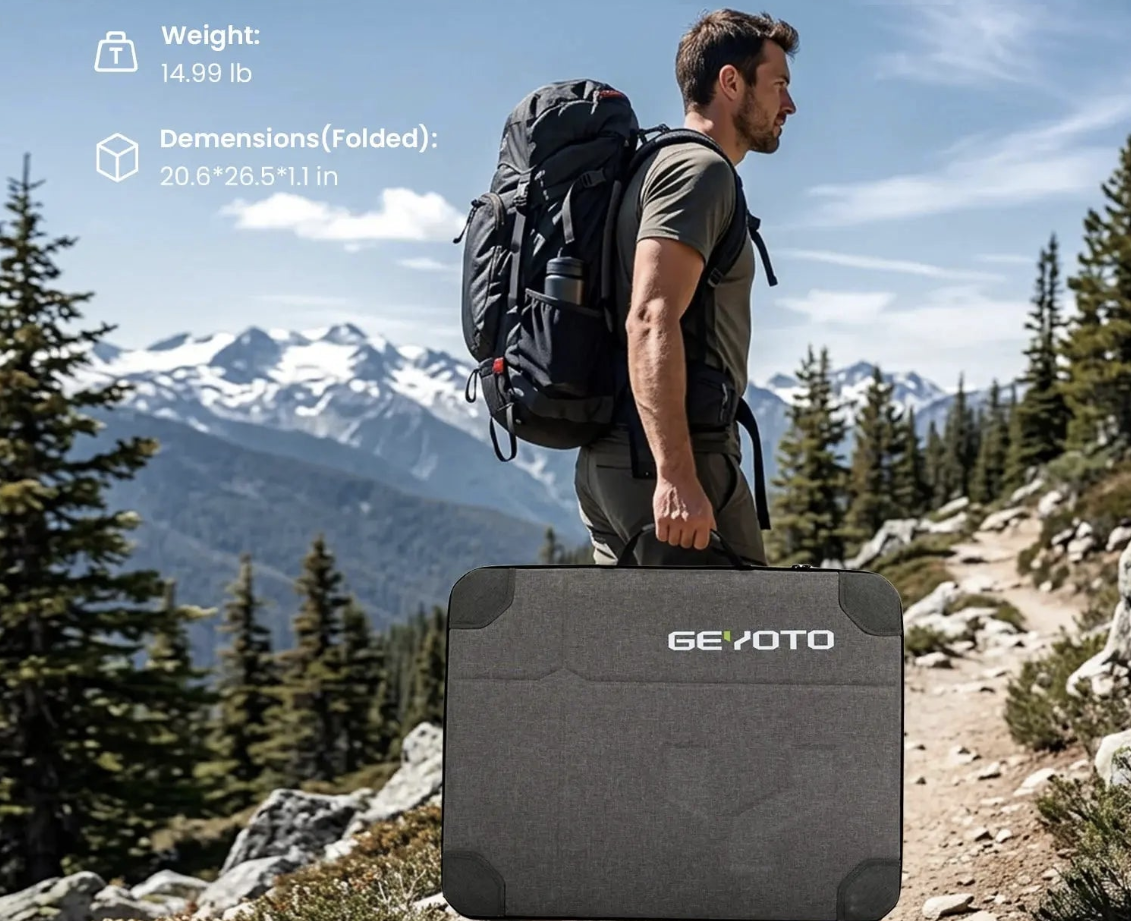
Long-distance highway travel demands efficient space utilization inside the vehicle cargo area. Packing luggage, camping gear, and food supplies leaves very little room for bulky, rigid solar hardware. Therefore, advanced folding structures provide an exceptional solution by minimizing the physical footprint of the stored equipment. An innovative four-panel layout allows a wide 2088-millimeter active surface area to fold down into a compact 522-millimeter storage width. This thin, streamlined profile slides easily into narrow interior gaps, such as beside passenger luggage or beneath bedding support structures.
Consequently, families can pack their vehicles completely without sacrificing valuable living space. Once the family arrives at a roadside rest stop, the panel deploys within sixty seconds to capture immediate sunlight. This rapid setup capability allows travelers to charge their devices during quick lunch breaks. More importantly, it eliminates the need to permanently modify the vehicle roof structure. The multifunctional design also utilizes a rigid Ethylene-Vinyl Acetate case as an active ground protective barrier. This heavy-duty exterior shell shields the underlying photovoltaic cells from sharp rocks and damp roadside terrain. Additionally, the interior reflective lining increases localized albedo, bouncing stray light onto the rear cells to boost power output. This versatile configuration works perfectly whether deploying panels at a remote campsite or establishing emergency backup power during a sudden household scenario utility failure.
Conclusion: Securing Multi-Generational Travel Freedom Through Verified GEYOTO Engineering
Constructing a dependable off-grid mobile grid requires careful calculation, universal compatibility, and smart spatial planning. By avoiding arbitrary power estimates and selecting standardized components, families can enjoy absolute energy independence on the road. GEYOTO(GEYOTO Technology Limited) supports this journey toward mobile freedom by manufacturing exceptionally rugged, high-efficiency solar hardware. The enterprise keeps things simple for US-based families by shipping every order free of charge straight from its own US warehouse. This strategic domestic logistics network ensures fast product delivery and immediate parts availability for customers across the country. Every panel comes with a standard 1-year warranty, extendable to 3 years for registered members. Planning your next family road trip? Compare the S100 and S200 and order at https://www.geyoto.com/.
Reverse Electrodynamics: Quantifying Family Watt-Hour Demands to Size Your Solar Input
To avoid sudden energy shortfalls, families must conduct an empirical load audit before embarking on long journeys. This technical process involves listing the power ratings of every onboard appliance. Operators must also estimate the daily operational hours for each device precisely. For example, multiplying a 50-watt compressor refrigerator by eight hours of daily runtime yields a baseline consumption of 400 watt-hours. Similarly, charging four smartphones and two tablets adds another 150 watt-hours to the daily energy balance sheet. For medical devices like CPAP machines, treat solar-charged power as a backup only — always keep a dedicated battery backup or grid access as your primary power source for medical equipment. Combining these values establishes the total daily watt-hour requirement for the entire vehicle setup.
Once travelers determine this total consumption figure, they can easily reverse-calculate the necessary solar generation capacity. Assuming an average of five peak sunlight hours per day, a standard 100-watt solar panel generates approximately 450 to 500 watt-hours. Obviously, this output barely covers the basic refrigerator load, leaving zero reserve capacity for other family electronic devices. Upgrading to a professional 200-watt platform effectively doubles the daily energy harvest to nearly 1000 watt-hours. This increased generation velocity provides a vital electrical buffer during overcast weather or high-latitude highway travel. The extra wattage ensures that the power storage core replenishes quickly. Consequently, this system preserves battery health and maintains continuous appliance operation throughout the night.
Protocol Standardization: Validating MC4 Interactivity Across Major Power Stations
Achieving seamless integration between solar harvesting components and existing battery networks requires strict adherence to industrial hardware standards. The open interface MC4 connection protocol serves as the premier choice for safe, low-resistance, and weatherproof energy transmission. These rugged locking connectors prevent accidental disconnections caused by physical trips or high winds at busy campsites. However, physical connectivity represents only the initial step in validating complete hardware compatibility. Families must carefully analyze the specific electrical profiles of both the panel and the receiving solar generator.
Specifically, verifying the Open Circuit Voltage, abbreviated as Voc, and the Short Circuit Current, noted as Isc, prevents dangerous electrical overloads. Connecting an incompatible panel can trigger internal circuit protections. It can also cause permanent damage to sensitive battery management systems. GEYOTO's S100 and S200 both use standard MC4 connectors, which plug straight into GEYOTO's own N300 and N1000 stations out of the box. This engineering choice simplifies the integration process significantly for GEYOTO's own ecosystem. When pairing with a third-party power station, don't assume compatibility from the connector shape alone — confirm the station's Voc range, input voltage, input current, and input power limits, plus connector type and polarity, before connecting. Skipping this check is what actually causes reverse-current faults and damaged battery management systems, not the connector itself.
The Efficiency Divergence: Combining Two 100W Panels in Parallel vs. a Single 200W Modular System
When planning a 200-watt solar upgrade, buyers often debate whether to buy two 100-watt panels or a single 200-watt unit. Two 100W panels wired in parallel add a couple of extra connectors and a small amount of line loss compared to one 200W unit — usually a minor difference, not a dramatic one. The bigger practical factor is convenience: one panel means fewer cables and a faster single-motion setup, while partial shading on either setup is best managed with a controller that has good bypass-diode handling. For parents managing active campgrounds, the single-panel design drastically reduces physical handling. A streamlined four-fold module sets up in seconds, providing maximum energy density without the hassle of extra wiring.
Spatial Ergonomics: Micro-Storage and Rapid Deployment Blueprints for 200W Folding Footprints on the Road
Long-distance highway travel demands efficient space utilization inside the vehicle cargo area. Packing luggage, camping gear, and food supplies leaves very little room for bulky, rigid solar hardware. Therefore, advanced folding structures provide an exceptional solution by minimizing the physical footprint of the stored equipment. An innovative four-panel layout allows a wide 2088-millimeter active surface area to fold down into a compact 522-millimeter storage width. This thin, streamlined profile slides easily into narrow interior gaps, such as beside passenger luggage or beneath bedding support structures.
Consequently, families can pack their vehicles completely without sacrificing valuable living space. Once the family arrives at a roadside rest stop, the panel deploys within sixty seconds to capture immediate sunlight. This rapid setup capability allows travelers to charge their devices during quick lunch breaks. More importantly, it eliminates the need to permanently modify the vehicle roof structure. The multifunctional design also utilizes a rigid Ethylene-Vinyl Acetate case as an active ground protective barrier. This heavy-duty exterior shell shields the underlying photovoltaic cells from sharp rocks and damp roadside terrain. Additionally, the interior reflective lining increases localized albedo, bouncing stray light onto the rear cells to boost power output. This versatile configuration works perfectly whether deploying panels at a remote campsite or establishing emergency backup power during a sudden household scenario utility failure.
Conclusion: Securing Multi-Generational Travel Freedom Through Verified GEYOTO Engineering
Constructing a dependable off-grid mobile grid requires careful calculation, universal compatibility, and smart spatial planning. By avoiding arbitrary power estimates and selecting standardized components, families can enjoy absolute energy independence on the road. GEYOTO(GEYOTO Technology Limited) supports this journey toward mobile freedom by manufacturing exceptionally rugged, high-efficiency solar hardware. The enterprise keeps things simple for US-based families by shipping every order free of charge straight from its own US warehouse. This strategic domestic logistics network ensures fast product delivery and immediate parts availability for customers across the country. Every panel comes with a standard 1-year warranty, extendable to 3 years for registered members. Planning your next family road trip? Compare the S100 and S200 and order at https://www.geyoto.com/.
GEYOTO Technology Limited
+ +1 213 292 9187
email us here
Visit us on social media:
Instagram
Facebook
YouTube
TikTok
Legal Disclaimer:
EIN Presswire provides this news content "as is" without warranty of any kind. We do not accept any responsibility or liability for the accuracy, content, images, videos, licenses, completeness, legality, or reliability of the information contained in this article. If you have any complaints or copyright issues related to this article, kindly contact the author above.